3-Pin Plug vs 7kW EV Charger — Speed, Safety & Real-World Comparison (2026)
Almost every new EV in the UK ships with a 'granny cable' — a thick lead with a normal 3-pin plug on one end. So why bother installing a 7kW home charger at all? This guide bins the marketing and walks through the real differences in speed, safety, efficiency, and long-term usability — with numbers you can actually plan around.
Short version: a 3-pin plug is a backup. A 7kW charger is what you live with.

Many Scottish EV drivers reduce charging costs further by combining smart tariffs with scheduled overnight charging.
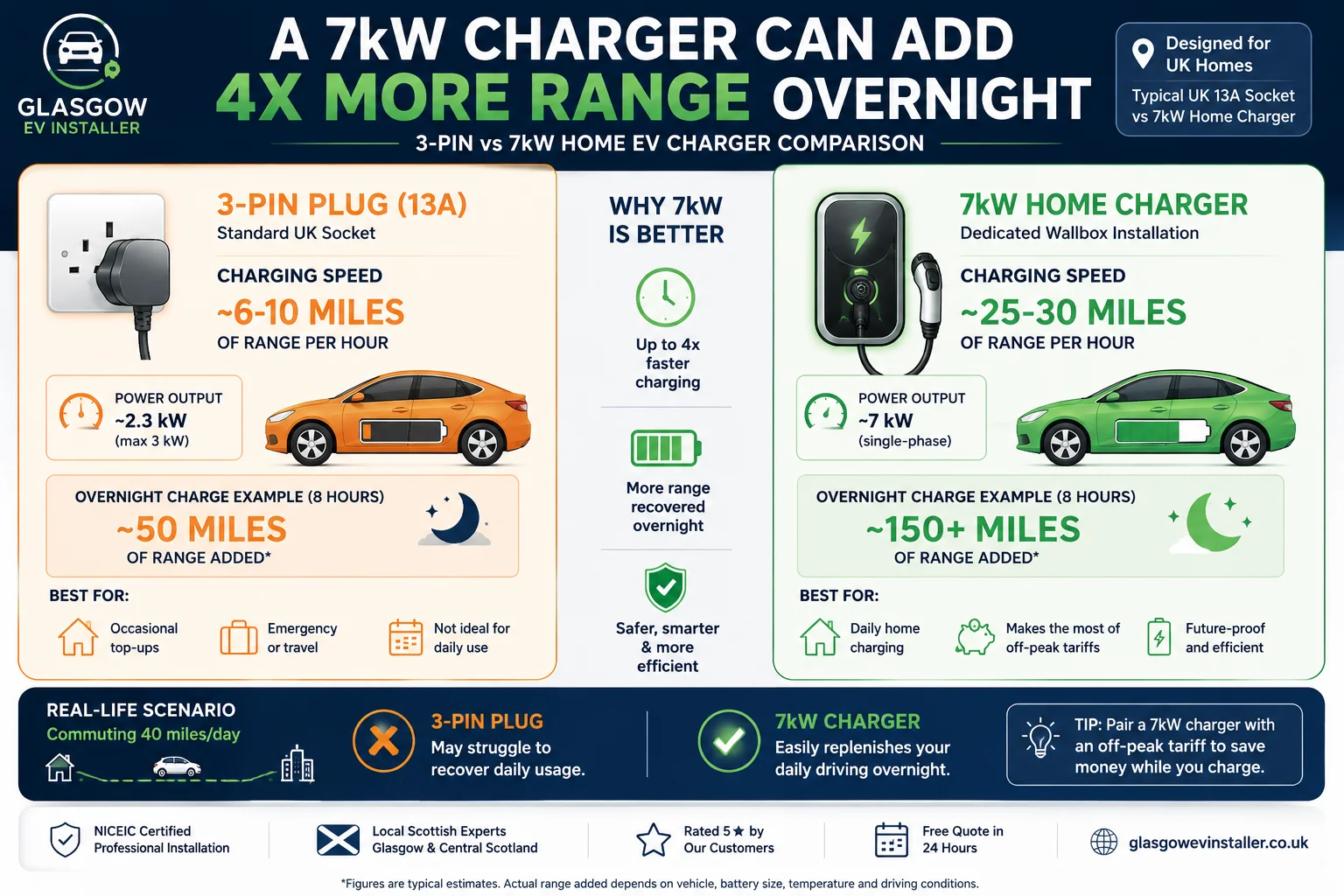
Infographic
A 7kW charger can add 4× more range overnight
3-pin plug vs 7kW home EV charger — at a glance
Average home EV driver saving
Charging at home using off-peak electricity tariffs is often significantly cheaper than relying on rapid public charging networks.
What does this depend on?
Savings vary depending on mileage, energy tariff, charging habits and public charging usage.
Charging speed — the difference is bigger than people think
A UK 3-pin socket is rated for 13A, but EV granny cables limit themselves to 10A (≈2.3kW) to stay safely below that ceiling for hours on end. A standard home charger delivers 7.4kW — about three times faster.
| Method | Power | Miles added per hour | Hours to add 200 miles |
|---|---|---|---|
| 3-pin granny cable | 2.3kW | 6–8 miles | ≈ 28 hours |
| 7kW home charger | 7.4kW | 25–30 miles | ≈ 8 hours |
| 22kW (3-phase, rare at home) | 22kW | 75–90 miles | ≈ 2.5 hours |
Visualise it as a fuel gauge
Picture your car's range bar. A 3-pin plug fills roughly one notch per hour on a typical EV display. A 7kW charger fills roughly four notches per hour. Same socket-side electricity, very different lived experience.
8-hour overnight comparison
- 13-pin (8 hrs): ≈ 50–65 miles added
- 27kW charger (8 hrs): ≈ 200+ miles — full charge for most EVs
Overnight charging — what actually happens by morning
Most people charge between roughly 11pm and 7am — eight hours, lined up with cheap-rate tariffs. Here's what each method gives you back in that window:
| Car (battery) | 3-pin (8 hrs) | 7kW (8 hrs) | Verdict |
|---|---|---|---|
| Nissan Leaf 40kWh | ≈ 50–65 miles | ≈ 200+ miles (full) | 7kW: comfortable. 3-pin: tops up only. |
| Tesla Model 3 LR (75kWh) | ≈ 55–65 miles | ≈ 200–230 miles | 7kW recovers a full daily commute easily. |
| Kia EV6 (77kWh) | ≈ 55–65 miles | ≈ 210–240 miles | 3-pin can't keep up with regular driving. |
| Hyundai Ioniq 5 (84kWh) | ≈ 55–65 miles | ≈ 210–240 miles | Same story — 3-pin will fall behind by week's end. |
| VW ID.3 (58kWh) | ≈ 55–65 miles | Full charge possible | 7kW = full battery overnight. |
Reality check: if your daily round-trip is under 50 miles and you only drive 4 days a week, a 3-pin plug can technically keep up. Beyond that, you start losing ground every week.
Real-world Glasgow scenarios
Scenario 1 — Bearsden commuter, 35-mile round trip
Plugs in at 6pm, leaves at 7:30am — 13.5 hours on the cable. 3-pin returns ≈ 90 miles, 7kW returns 200+ miles. Both technically cover the commute, but the 3-pin user has zero buffer for an unplanned trip and pays peak-rate electricity because there is no smart scheduling.
Scenario 2 — Paisley family, two cars, weekend trips
200 miles on a Saturday to visit family. A 3-pin needs 24+ hours to recover that, meaning the car is off the leash by Monday lunchtime at best. A 7kW recovers it overnight on a cheap-rate tariff for around £6 of electricity.
Scenario 3 — West End flat with allocated bay
Trailing a granny cable down a tenement stairwell to a courtyard bay is neither legal nor safe — extension leads outside aren't permitted for EV charging, and ring-final circuits weren't designed for it. The only honest answer here is a properly installed wall unit.
Side-by-side comparison
| Factor | 3-pin granny cable | Dedicated 7kW charger |
|---|---|---|
| Charging speed | 2.3kW (6–8 mi/hr) | 7.4kW (25–30 mi/hr) |
| Efficiency | Lower — 10–15% losses at low power | Higher — typically 5–8% losses |
| Safety | OK on a modern dedicated socket; risky on old/worn sockets used nightly | Dedicated circuit, RCD type-A/B + 6mA DC protection, certified install |
| Smart tariff support | None — tariff cannot control the plug | Yes — Octopus Intelligent, OVO Charge Anytime, etc. |
| Solar PV diversion | No | Yes (Zappi, Hypervolt etc.) |
| Outdoor / wet use | Not designed for it — socket must be indoors or under proper IP-rated cover | IP54+ rated unit designed for outside walls |
| Long-term usability | Backup / occasional only | Designed for 10–15 years of daily charging |
| Insurance & warranty | Some EV warranties discourage daily granny use | Manufacturer-recommended install method |
Myth-busting
“A 7kW charger will trip my house electrics.”
No — a 7kW charger is fitted on its own dedicated 32A circuit straight from the consumer unit, with its own RCD protection. It doesn't share a ring with your kettle or oven. A modern UK supply (60–100A main fuse) handles a 7kW charger comfortably.
“Slow charging is better for the battery.”
Mostly a myth at this scale. EV battery degradation comes mainly from rapid DC charging (50kW+) and sitting at 100% for long periods. AC charging at 7kW is gentle on the battery — there is no meaningful difference in pack longevity between 2.3kW and 7.4kW.
“The granny cable came in the box, so it must be fine forever.”
Manufacturers ship the granny cable as an emergency option. Read the documentation — most explicitly describe it as occasional-use and recommend a dedicated wallbox for routine charging.
“It's cheaper to just keep using the 3-pin.”
Over a year, no. A 7kW charger on Octopus Intelligent Go (≈7p/kWh overnight) saves roughly £300–£600 a year vs a 3-pin on a standard tariff (≈27p/kWh) for a typical 8,000-mile-a-year driver. The charger pays for itself in 2–3 years.
When a 3-pin plug is genuinely fine
- You drive a plug-in hybrid with a 10–15kWh battery
- You're waiting on an installation date and need a stop-gap for 1–2 weeks
- You charge mainly at work or public chargers and only top up at home
- Total mileage is well under 5,000 miles a year and you can plug in 24+ hours at a time
When you should install a 7kW charger
- You drive most days and want the car ready every morning
- You want access to cheap-rate smart tariffs (Octopus Intelligent Go, OVO Charge Anytime)
- You have solar PV — only a 7kW smart charger can divert surplus generation
- Your only socket is in a garage, hallway, or kitchen — running a granny cable outdoors isn't safe long-term
- You plan to keep an EV for 3+ years
Verdict
A 3-pin plug is a fallback. It charges your car at walking pace, can't take advantage of cheap overnight tariffs, and was never designed for sustained nightly use. A 7kW home charger is three times faster, safer on its own dedicated circuit, more efficient, and pays for itself within a couple of years on a smart tariff. For any EV driver in Glasgow with off-street parking, it's the only sensible long-term answer.
Get a fixed-price 7kW installation quote
We connect Glasgow homeowners with NICEIC-approved installers who handle the survey, OZEV paperwork (where eligible), DNO notification, and certification. Free site survey, fixed quote within 24 hours, typically installed within 7 days.
Related questions
- →Which EV charger is best for a UK home in 2026?
- →Tethered or untethered — which should I choose?
- →Can I just use a 3-pin plug instead of a 7kW charger?
- →Which chargers work best with Octopus Intelligent Go?