OZEV Grant Scotland 2026 — Who Qualifies, How Much, and How to Claim
If you're planning to have an EV charger installed in Scotland and you've heard there's a government grant available, you're right — but the rules have changed significantly over the past few years, and a lot of guides online are out of date.
This is a plain-English breakdown of every EV charger grant available to Scottish residents in 2026, who qualifies for each one, and exactly how the application process works. Scotland actually has more grant support than anywhere else in the UK — but it takes a bit of untangling to understand what's on the table.
This quick flowchart helps Scottish EV drivers understand whether they may still qualify for EV charger grants or support schemes in 2026.
Infographic
Can you get an EV charger grant in Scotland? — 2026 eligibility flowchart
Homeowner, flat, landlord or rural — see your likely route in 30 seconds
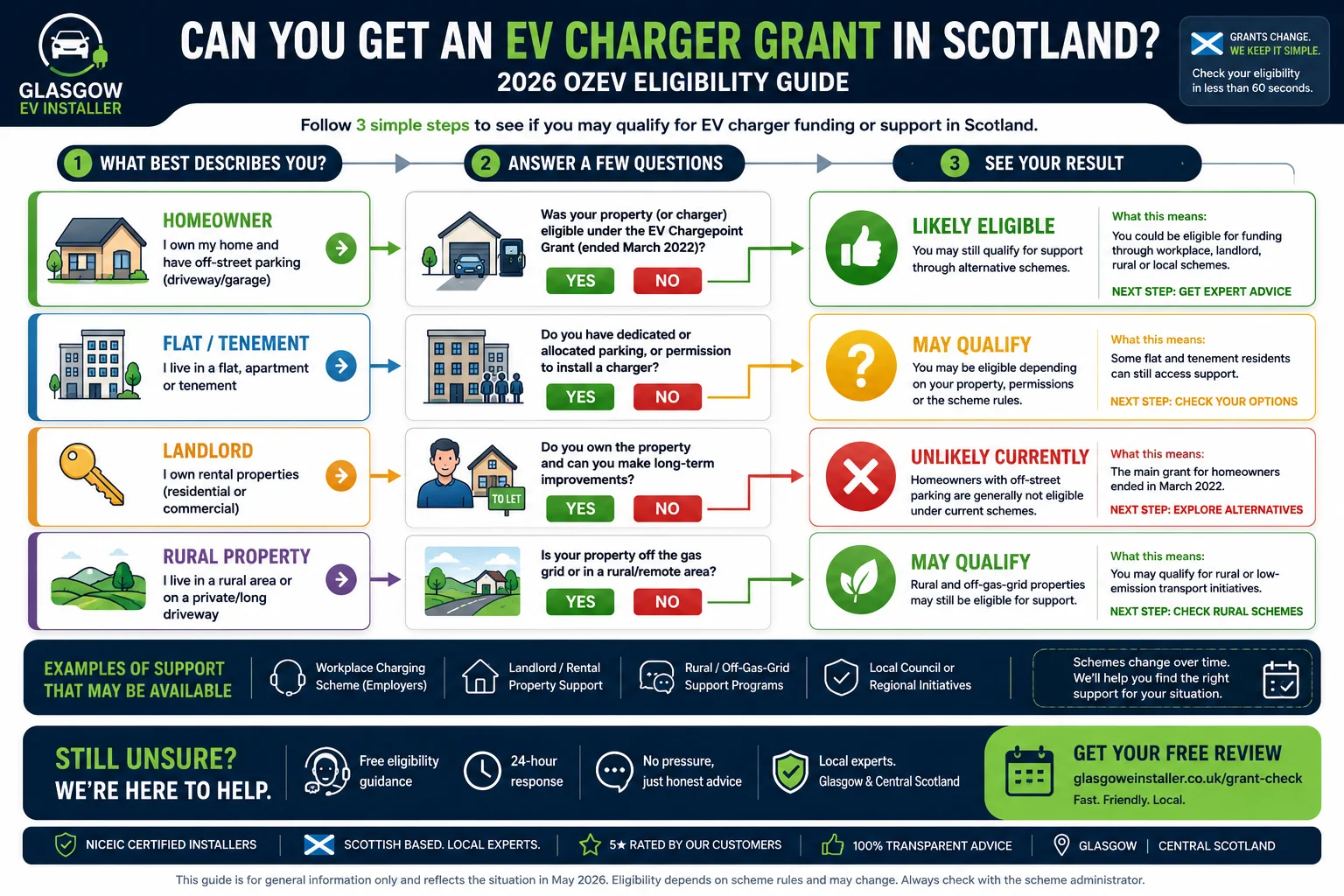
*With the right setup & permissions
Flats, tenements and homes without driveways may still support EV charging through shared, kerbside or alternative installation solutions.
What does this depend on?
Support depends on property layout, electrical capacity, permissions and parking access.
The quick summary
Here's what's currently available in Scotland in 2026:
| Grant | Who it's for | Max amount | Status |
|---|---|---|---|
| OZEV EV Chargepoint Grant | Renters and flat owners | £500 | Open |
| OZEV Residential Landlord Grant | Landlords | £500 per socket (up to 200) | Open |
| OZEV Workplace Charging Scheme | Businesses | £500 per socket (up to 40) | Open |
| OZEV On-Street Parking Grant | No off-street parking | £500 | Open |
| EST Domestic Chargepoint Grant | Rural EV owners / Used EV loan recipients | £400 | Reopening soon |
| EST Factored Development Grant | Property factors / managers | 25% of cost | Open |
Homeowners of houses — detached, semi-detached, or terraced — are not currently eligible for any home charger grant. That changed in April 2022 and has not been reversed.
Grant 1: OZEV EV Chargepoint Grant for renters and flat owners
This is the main grant for most Scottish EV drivers who don't own a house. As of April 2026, it covers up to £500 — or 75% of your total installation cost, whichever is lower.
Who qualifies
- Renters in any type of property — house, flat, or apartment
- Leasehold flat owners (including tenement flat owners in Scotland)
- You must have a dedicated, private off-street parking space
- You must own, lease, or have an eligible EV on order
- You must not have previously claimed this grant or its predecessor (the EVHS)
What it covers
The £500 cap includes both the charger unit and the installation labour. So if your total installation cost is £900, the grant covers £500 and you pay £400. If your total is £600, the grant covers £450 (75%) and you pay £150.
Important — the charger must not be installed before approval. This is one of the most common mistakes people make. You must receive confirmation from OZEV that you're eligible before your installer touches anything. If the charger goes in before you're approved, you cannot claim the grant.
How the application works
You do not apply to OZEV directly for this grant. Your OZEV-authorised installer applies on your behalf and deducts the grant from your invoice. The process is:
- Get a quote from an OZEV-authorised installer
- Gather your supporting documents (see below)
- Your installer submits the grant application on your behalf via the GOV.UK Find a Grant platform
- OZEV notifies you and your installer by email — typically within 10 working days
- Installation takes place after approval
- Installer claims the grant and deducts it from your final bill
Documents you'll need
- Utility bill less than 3 months old showing your name and property address
- Proof you own, lease, or have ordered an eligible EV
- Written permission from your landlord or factor (if applicable) — must name you and reference the property address
- Quote from your OZEV-authorised installer
Eligible chargers
Not every charger type qualifies. The charger must be on the OZEV approved list — this includes popular models like the Ohme Home Pro, Pod Point Solo 3, Zappi, Easee, and Hypervolt. The Tesla Wall Connector is not currently on the approved list and does not qualify for the grant.
The scheme is confirmed until 31 March 2027. After that date, its future is uncertain. If you're eligible, applying sooner rather than later is advisable.
Grant 2: OZEV Residential Landlord Chargepoint Grant
If you're a landlord with residential rental properties in Scotland, this grant covers up to £500 per socket for up to 200 sockets per year across your sites.
Who qualifies
- Private landlords, property management companies, housing associations, and freeholders of residential properties
- You must be registered at Companies House or VAT registered with HMRC
- The properties must have associated off-street parking accessible to tenants
- The properties cannot be solely used for holiday accommodation
How it works
Unlike the renter/flat owner grant, landlords apply directly. Your installer then claims the grant on your behalf once the work is complete. The grant amount is deducted from your invoice — you don't receive a cheque and pay in full upfront.
This grant is particularly valuable for landlords with multiple properties — at £500 per socket for up to 200 sockets, the maximum total support available is £100,000 per year.
Grant 3: OZEV Workplace Charging Scheme (WCS)
For businesses, charities, and public sector organisations in Scotland installing EV chargers for staff or fleet vehicles.
Who qualifies
- Any UK business, charity, or public sector organisation
- Must have dedicated off-street parking for staff
- The chargers must be for staff use — not public access
What it covers
75% of the cost of purchase and installation, up to £500 per socket for up to 40 sockets across all your sites. That's a maximum of £20,000 in total support per applicant. The grant increased from £350 to £500 per socket on 1 April 2026.
Home-based business owners whose home address is also their registered business address may also be eligible for the WCS for up to £500 toward a home charger — worth checking if you run a business from home.
Grant 4: OZEV On-Street Parking Grant
For Scottish residents who don't have a driveway or off-street parking. This is a relatively new and still-developing scheme.
Who qualifies
- You own or rent a residential property in Scotland
- You do not have private, exclusive off-street parking
- You must install a permanent cross-pavement charging solution alongside the charger — temporary cable covers or mats do not qualify
- You must obtain consent from Glasgow City Council (or your local highways authority) before applying
What it covers
Up to £500 toward the combined cost of the chargepoint and cross-pavement installation. The cross-pavement element — a channel cut into the pavement to route the cable — is what makes this scheme work and what distinguishes it from simply running a cable across the pavement, which is not permitted.
Important for Glasgow residents: Glasgow City Council has been establishing policies for cross-pavement solutions, but not all streets are approved. The right first step is to contact Glasgow City Council's roads department to confirm whether a cross-pavement solution is permitted at your address before progressing any further.
Grant 5: Energy Saving Trust Domestic Chargepoint Grant (Scotland only)
This is the grant that makes Scotland the most generously supported region in the UK for EV charger installation. It is in addition to the OZEV grants above — and where eligible, the two can be combined.
Funded by Transport Scotland and administered by the Energy Saving Trust, this grant offers up to £400 toward the cost of installing a home EV charger.
Who currently qualifies
- Rural EV owners — residents living in rural or remote areas of Scotland, including islands
- Used EV loan recipients — people who purchased their EV through the Scottish Government's Used Electric Vehicle Loan scheme
Current status
The 2025/26 round of the EST Domestic Chargepoint Grant closed to new applications in January 2026. The 2026/27 round is expected to reopen during this financial year — the Energy Saving Trust has confirmed the fund will reopen and has invited interested residents to register for notification.
If you think you might be eligible, register your interest now at energysavingtrust.org.uk so you're notified the moment applications reopen. Grants are offered on a first-come, first-served basis and the fund closes when the budget is used up — often within weeks of reopening.
Critical difference from OZEV: Unlike the OZEV grant, you apply for the EST grant directly yourself — not through your installer. And you must apply and receive a grant offer letter before installation begins. The EST will not fund an installation that has already taken place.
Can you claim both the OZEV grant and the EST grant?
Yes — if you're eligible for both, you can stack them. An eligible renter in a rural Scottish location who purchases an EV through the Used EV Loan scheme could in theory claim both the £500 OZEV grant and the £400 EST grant, reducing their installation cost by up to £900. You apply for each separately, and your installer must be approved by both OZEV and the Energy Saving Trust.
Grant 6: EST Factored Development Chargepoint Grant (Scotland only)
Specifically for property factors and managers of residential developments in Scotland — directly relevant to Glasgow's large tenement stock.
This grant covers up to 25% of the cost of installing communal EV charging infrastructure in factored developments. It is applied for by the factor or property manager, not by individual residents.
If you live in a Glasgow tenement with a factor, it may be worth raising this with them directly — it's a legitimate route to get shared EV charging installed in your rear court or communal parking area at reduced cost, and many factors are now familiar with the scheme.
What grants closed in March 2026
Several OZEV schemes closed to new applications on 31 March 2026 and will not return:
- The Staff and Fleet infrastructure grant for SMEs
- The Residential Infrastructure grant (which covered cable runs and electrical upgrades in addition to charger units)
If you were considering these, they are no longer available.
How to avoid common mistakes
Don't install before you're approved. Both OZEV and EST grants require approval before installation begins. If the charger is installed first, you cannot claim. This is the most common reason grant applications fail.
Make sure your installer is approved for the right grants. For the OZEV grant, your installer must be OZEV-authorised. For the EST Domestic Chargepoint Grant, they must be approved by both OZEV and the Energy Saving Trust — this is a separate approval and not all OZEV installers hold it. Check before you book.
Check your charger is on the approved list. An OZEV-authorised installer will know this, but it's worth confirming. If you have your heart set on a particular model, check the OZEV approved charger list before committing.
Get your permissions in order first. If you're a renter or flat owner, you need written landlord or factor permission before you can apply. Getting this in place before approaching an installer will speed up the process considerably.
The EST grant is first come, first served. When the Scottish fund reopens, it fills up quickly — sometimes within weeks. Register your interest now so you can apply immediately when it reopens rather than missing the window.
Who is not eligible for any home charger grant
To be completely clear: if you own a house — detached, semi-detached, or terraced — and it is your primary residence, you are not currently eligible for any government home EV charger grant. The OZEV homeowner grant (formerly the EVHS) was withdrawn in April 2022 and has not been reinstated.
If you own your home and want to install a charger, you pay the full cost. The typical installation cost range for Glasgow is £800–£1,500 for a standard installation.
Ready to get a quote?
We connect Scottish residents with certified, OZEV-authorised EV charger installers across Glasgow and central Scotland. A free survey will confirm your eligibility, identify which grants apply to your situation, and give you an accurate fixed price.
Related questions
- →Am I eligible for the OZEV chargepoint grant in Scotland?
- →Do flat owners qualify for EV charger funding?
- →Can landlords claim the OZEV grant?
- →When does the OZEV grant scheme end?